Bundle
dsh-baize-session
Pick messages out of DeepSeek Harness sessions and relocate them into another session's opening context (Baize).
- Source
- bvcvb
- License
- MIT
- Updated
- Updated yesterday
Readme
# dsh-baize-session
**[English](README.md) | [简体中文](README.zh.md)** — 中文说明见 [README.zh.md](README.zh.md)。


`dsh-baize-session` (Baize) is a [dsh](https://www.npmjs.com/package/@deepseek-ai/dsh) plugin that does two things with conversations:
- **Moves context between them** — pick messages out of the conversation you are in, then carry them into another one: an existing conversation, or a brand-new one in a different workspace.
- **Manages the conversations of one workspace** — list them all (archived ones included), archive, restore, delete for real, and relocate to another workspace, from one tab.
The name comes from **Baize (白泽)** — a mythical beast said to understand all things. Where [`dsh-baize-rules`](https://www.npmjs.com/package/dsh-baize-rules) injects *requirements*, this plugin relocates *context*.
- The picked messages are **rewritten as text** into a single `user/message` carrying `source.kind='plugin'`, `plugin='baize-session'` — not replayed as events. An arbitrary selection cannot be replayed: the session store validates that a seed is contiguous from seq 0, so a partial history is not a valid prefix.
- The injected block ends with `当前工作区是 <path>。请在此基础上继续。` — the model is told that the quoted history came from other directories, with no path rewriting anywhere.
- **No selection → nothing is written.** The plugin refuses an empty basket instead of injecting an empty frame.
- Everything destructive is **gated**: a conversation must be archived before it can be deleted, and an archived conversation cannot be moved at all.
---
## Features
| Feature | Description |
|---|---|
| **Pick from the conversation you are in** | The 整理 pane lists this conversation's messages as a checkbox table. Click a row to read it whole; tick the checkbox to select it |
| **Collect from anywhere** | A `+` button sits next to every assistant reply, so material can be grabbed without leaving the chat flow. The basket is keyed per conversation |
| **Two destinations** | **New conversation** in a chosen workspace (created with the content as its seed), or **append** to a conversation that is currently open |
| **Cross-workspace by construction** | A new conversation is created with the target workspace as its `cwd`, so it lands in that project's session directory — moving context between projects needs no path rewriting |
| **Named conversations, not ids** | Pickers show each conversation's own logged title (`session/title`), falling back to its opening line. The raw id lives in the row's detail pane |
| **Rows labelled by author** | `user` / `assistant` / `context` / `tool`, with the colours of the official Trajectory view's kind tags. `context` matters: dsh logs human prompts and harness injections under the *same* `user/message` event type |
| **Token budget** | The rendered block is estimated before writing; a selection above `maxInjectTokens` is refused with the measured number instead of silently truncating |
| **Workspace management** | The 工作区 pane lists every conversation of the current workspace — archived ones included — with archive / restore / move / delete per row, plus multi-select for batch actions |
| **Conversations move while open** | Relocating a conversation that is still in memory works: the plugin flushes it, rewrites its artifact under the coordinator's per-id lock, and retargets the persisted write path so later messages land in the new location |
| **Only real conversations are offered as targets** | Blank and archived conversations are filtered out of the 整理 pane's destination picker — the same rule the official sidebar uses (`sessionVisible`) |
| **One runtime, two surfaces** | The panel and the `/baize-session` command drive the same runtimes, so they can never disagree |
| **No data files of its own** | The plugin keeps no state on disk of its own; what it changes (session artifacts, the workspace registry) belongs to dsh |
---
## Installation
> dsh plugins are distributed from npm and installed into a profile via `dsh plugin`.
```bash
# Install from npm into the web profile (use the actual published version)
dsh plugin --profile web add dsh-baize-session@0.1.1
pm2 restart dsh # Reload when dsh is managed by pm2
dsh --profile web
```
Peer dependencies (`@deepseek-ai/*`) are provided by the dsh profile; if any are missing, pnpm resolves them against `peerDependencies` in the profile directory. The plugin declares `dsh.bundle` (mounts itself through `cordis.patch.yml`) and `dsh.client` (its browser half), which is what makes both halves load.
### Uninstall
```bash
dsh plugin --profile web remove dsh-baize-session
pm2 restart dsh # Reload when dsh is managed by pm2
```
If the entry lingers in the profile's `dsh.profile.bundles`, delete that line from
`$DSH_HOME/profiles/web/package.json` and restart dsh again. Nothing else is left behind: this plugin
writes no data of its own (see [Data location](#data-location)).
### Try it without touching your running setup
Install into a **separate profile** so your currently running dsh stays unchanged:
```bash
dsh plugin --profile smoke add dsh-baize-session@0.1.1
dsh --profile smoke --dump-config # compose the config only — does not boot dsh
```
### Local development (link)
```jsonc
// $DSH_HOME/profiles/web/package.json
"dependencies": {
"dsh-baize-session": "link:/home/abc/work/plugin/dsh-baize-session"
}
```
Then run `pnpm install` in the profile directory and add `dsh-baize-session` to `dsh.profile.bundles`.
---
## Quick Start
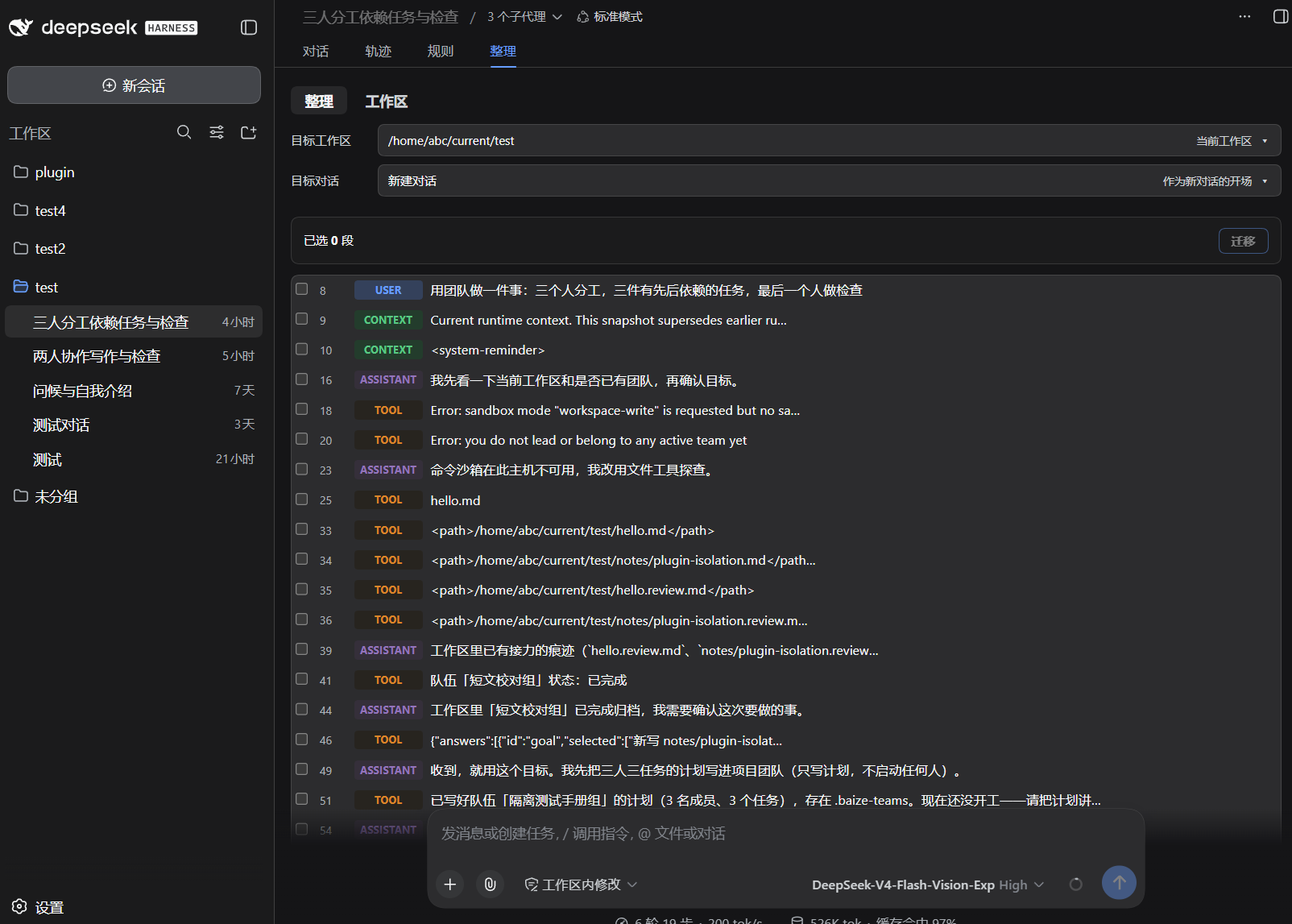
Open any conversation and click the **整理** tab next to the chat view. That one tab holds two panes, switched by the tabs in its title row:
```
[对话] [轨迹] [规则] [整理] ← the top tab strip (this plugin owns 整理 only)
──────────────────────────────────
整理 | 工作区 ← the two panes
```
### 整理 — move messages into another conversation
```
① target workspace [ /home/abc/work/plugin ▾ ]
② target conversation[ New conversation ▾ ]
─────────────────────────────────────────────────────────────
Selected 0 items [ Clear ] [ Relocate ]
─────────────────────────────────────────────────────────────
12 USER the first line of the message… ← click to read
13 CONTEXT Current runtime context. This snapshot…
14 ASSISTANT the first line of the reply…
```
1. Pick the workspace (the current one is preselected and listed first; the last entry lets you type an absolute path).
2. Pick the conversation — `New conversation`, or any real conversation in that workspace.
3. Tick the messages to carry over. Clicking a row shows its full text and does **not** select it.
4. Press **Relocate**.
### 工作区 — manage this workspace's conversations
```
Workspace: /home/abc/current/test [ All 7 ] [ Active 6 ] [ Archived 1 ]
─────────────────────────────────────────────────────────────────────────────
Selected 0 items [ Archive ] [ Restore ] [ Move ] [ Delete ]
─────────────────────────────────────────────────────────────────────────────
☑ 问候与自我介绍 已对话 未打开 09-15 17:58 · 24 messages [ Archive ] [ Move ]
☑ 测试 已对话 进行中 09-20 12:42 · 31 messages [ Archive ] [ Move ]
☐ 已归档的对话 已对话 已归档 09-20 12:42 · 6 messages [ Restore ] [ Delete ]
```
| Action | Where | Rule |
|---|---|---|
| **Archive** | row button, or batch bar | any conversation, open or closed |
| **Restore** | row button, or batch bar | archived conversations only |
| **Move** to another workspace | row button, or batch bar | **not archived**; works for open conversations too |
| **Delete** (removes the stored log) | row button, or batch bar | **archived only**, and needs a second click to confirm |
Clicking a row (anywhere except a button or a checkbox) expands its detail line: the full session id, creation time, message count, workspace path and whether it is currently open.
The same operations are reachable from the keyboard:
```bash
/baize-session # Same as info: this conversation's id, workspace, message counts
/baize-session take 12 14 # Collect messages by seq (from this conversation)
/baize-session list # Every real conversation, grouped by workspace
/baize-session to /home/abc/work/led # Create a new conversation there, carrying the basket
/baize-session add session-1a2b… # Or append into an open conversation
/baize-session drop # Empty the basket
```
---
## Commands
| Subcommand | Syntax | Purpose |
|---|---|---|
| **info** | `/baize-session [info\|status]` | Show this conversation's id, workspace, message/basket counts, and the most recent `listLimit` messages with their seqs |
| **take** | `/baize-session take <seq…>` | Collect messages by seq out of the current conversation |
| **list** | `/baize-session list` | List the real conversations (blank and archived ones are counted in a trailing note, not listed), grouped by workspace, with names and ids |
| **drop** | `/baize-session [drop\|clear]` | Empty the basket |
| **to** | `/baize-session [to\|move] <absolute path>` | Create a new conversation in that workspace and write the basket into it as its opening context |
| **add** | `/baize-session [add\|append] <session id>` | Append the basket into an existing conversation — it must be open (in memory) |
---
## Conversation kind and state
Every row in the 工作区 pane carries **two independent badges**, because they answer different questions:
| Column | Values | Question it answers | Rule |
|---|---|---|---|
| **kind** | `空对话` / `已对话` / `子代理` | is there a conversation in it yet? | `blank` — no `turn/start` has ever been logged |
| **state** | `进行中` / `已打开` / `未打开` / `已归档` | where does it live right now? | an agent is attached / held in memory / stored on disk / in the archive set |
They are not alternatives. An **empty conversation can be in progress** — an agent is attached the moment a conversation is created, before its first prompt — and a conversation with content can be closed. Folding the two into one badge said one thing at the cost of the other.
`已归档` outranks the rest of the state column (it is what the sidebar hides on), and `子代理` outranks kind (a subagent child cannot be moved).
---
## The panel
Both panes live inside the **one** `conversation.view` tab this plugin owns (id `baize-session-tidy`, order 40) — purely additive: no official component is replaced. The `+` button is registered on `conversation.chat.assistant-actions` (id `baize-session-collect`, order 20).
Shared behaviour:
| Interaction | Result |
|---|---|
| Click a row | Expand/collapse that row's **full text** (整理) or its **detail line** (工作区). Neither selects it |
| Click a checkbox | Select/deselect; the detail stays as it is |
| The action bar | Always present, the same `.baize-bar` in both panes. Its buttons are **disabled, not hidden**, while nothing is selected |
| Dropdowns | Self-drawn popovers (a native `<select>` does not match the dsh theme); click outside or press Escape to close |
整理 pane specifics: the content list is always the current conversation; the message table grows and shrinks with the window (no fixed height).
工作区 pane specifics: the title/filter row and the tab row are both 32px so nothing sits lower than its neighbour; the kind and state columns are a fixed 76px each and the time column a fixed 150px, so they line up down the table instead of drifting with the label lengths.
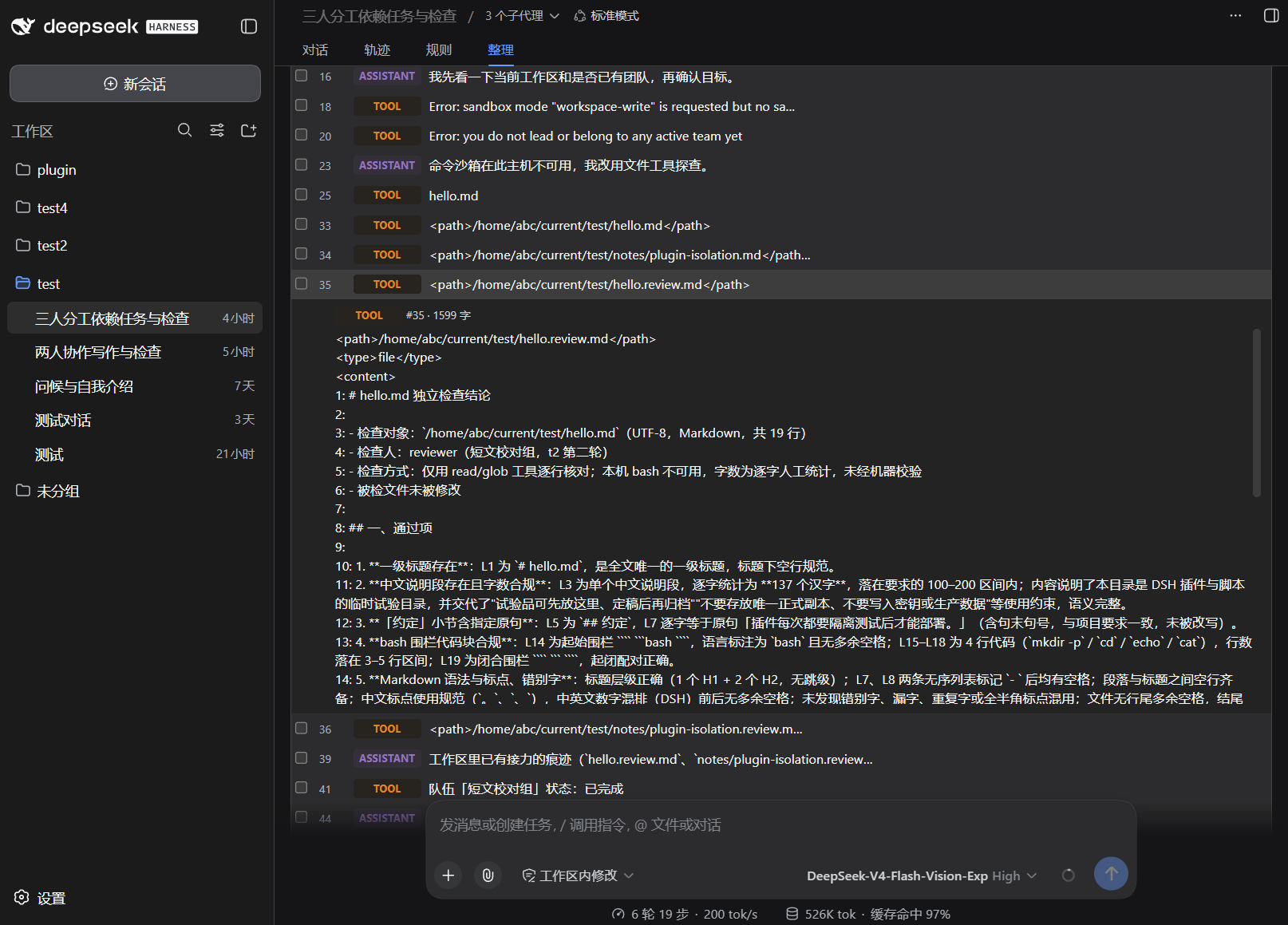
Message rows are labelled by author:
| Badge | Meaning | Colour source (official Trajectory view) |
|---|---|---|
| `USER` | A human prompt (`source.kind === 'user'`) | `.user` — `state-business-primary` / `state-business-tertiary` |
| `ASSISTANT` | A model reply | `.assistantVioletBright` |
| `CONTEXT` | Injected by a plugin or the harness — runtime snapshots, `<system-reminder>`, memory injections, and this plugin's own relocation blocks | `.contextGreen` |
| `TOOL` | A tool result (`tool/result` events) | `.toolAmber` |
`user/message` is **not** a synonym for "the user said this": dsh stores human prompts and injected context under that one event type, separated only by `data.source.kind`. In a sampled real session the split was `{user: 4, plugin: 10}` — most of that conversation was never typed by anyone, which is exactly why the two are badged differently.
---
## What gets injected
One `user/message` per relocation, built with `createUserMessage()` and published with the surface marker `{ surfaceOp: 'append' }` that surface-eligible events require:
```text
以下是本会话开始前,我(用户)从其它会话整理过来的上下文,供你参考:
【来自会话 06094031 / 工作区 /home/abc/work/plugin】
user: where is the token budget enforced?
assistant: in relocate.ts, before the write — it throws instead of truncating.
---
当前工作区是 /home/abc/work/led。请在此基础上继续。
```
- Messages keep their **author label** (`user:` / `assistant:` / `context:` / `tool:`) so the receiving model can tell a question from an injection.
- Material is grouped by source conversation, preserving collection order.
- When the destination is an existing conversation, the block is appended as a normal message; when it is a new conversation, the very same message becomes the **seed** of that session. A seed is used because dsh persists on checkpoints: a brand-new session nobody has talked to never reaches disk through `append`.
- The new session is then attached to its workspace (`workspace.attachSession`), which is what makes it appear in the sidebar.
---
## Which conversations are listed
The two panes filter differently, on purpose:
| | 整理 — destination picker | 工作区 — the table |
|---|---|---|
| Blank (no turn ever ran) | **hidden** | listed, kind `空对话` |
| Archived | **hidden** | listed, state `已归档` (until you filter them out) |
| Subagent children | hidden | listed, kind `子代理` |
| Everything else | listed, by name | listed, by name |
The 整理 picker exists to answer "where can this go", so it offers only destinations that make sense; the 工作区 table exists to answer "what is in here", so it shows everything and lets you act on it. Both come from the same session listing, so they can never contradict each other.
---
## Rules the operations enforce
| Operation | Refused when | Message |
|---|---|---|
| Relocate into an existing conversation | the target is not open (not in memory) | `目标会话不在内存中,无法追加(先在侧边栏打开它)。` |
| Relocate | the basket is empty, or the estimate exceeds `maxInjectTokens` | the refusal names the measured size |
| Relocate | the target path is relative | `目标路径必须是绝对路径:…` |
| Archive / Restore | the live registry exposes no write path (very old dsh) | `当前 dsh 版本未暴露…接口` |
| **Delete** | the conversation is **not archived** | `只能删除已归档的对话:请先归档,再删除。` |
| **Delete** | the request lacks `confirm: true` | `删除需要显式确认(confirm: true)。` |
| **Move** | the conversation is **archived** | `已归档的对话不能迁移:请先还原它。` |
| **Move** | the conversation is a subagent child | `子代理会话不支持跨工作区迁移。` |
| **Move** | the persisted artifact cannot be located | `当前持久化后端不支持定位会话工件,无法跨工作区迁移。` |
| **Move** | nothing is known that would point later writes at the new artifact | `当前运行时既不暴露 live 写入器、也不暴露持久化写入状态…` |
How a move actually works, in order — a conversation belongs to a workspace through its `cwd`, and the registry refuses to attach a session whose stored cwd disagrees with the workspace path, so the artifact is rewritten first and the ledger second:
1. If the conversation is **open**, flush its buffered events to the current artifact first.
2. Under the persistence coordinator's per-id lock (when the backend offers one), read the artifact, rewrite **only** the header line's `cwd` (keeping `version`), and write it to the path that cwd implies — through a temp file and atomic renames, with the original parked so a failure can put the bytes back.
3. Move the in-memory pointers with it: the live write state (`meta.cwd`), the in-memory session header, and the registry's header/path indexes — all restored together if the ledger swap fails.
4. Detach from the old workspace, attach to the new one, then drop the emptied old directory.
5. If anything fails, the original bytes go back to their original path. This matters more than it sounds: dsh validates at startup that a session's location matches its header `cwd`, and a mismatched pair makes it refuse to boot the whole plugin tree.
---
## Configuration (`Config`)
| Field | Type | Default | Meaning |
|---|---|---|---|
| `maxInjectTokens` | `number`, **required** | `8000`, set by this package's `cordis.patch.yml` | Refuse to write a block estimated above this many tokens. The refusal names the measured size, so a too-large selection is visible rather than silently trimmed |
| `listLimit` | `number`, optional | `15`, in-code (the patch does not set it) | How many recent messages `/baize-session info` lists |
The shipped patch is exactly this — add `listLimit` to the same `config` block to override it:
```yaml
# cordis.patch.yml
- insert:
- id: baize-session
name: 'dsh-baize-session'
config:
maxInjectTokens: 8000
```
---
## HTTP API
The browser half has no way to read a session, create one, or touch the workspace registry, so the panel talks to `/baize-session.api` on the host web server. It delegates to the same runtimes the command uses.
| Request | Body / query | Returns |
|---|---|---|
| `GET /baize-session.api` | `?sessionId=<id>` (required); `&source=<id>` lists another conversation's messages; `&view=workspace` returns the workspace pane instead | `PanelState` `{ sessionId, cwd, messages, basket, projects, sessions, maxInjectTokens }` — or, with `view=workspace`, `WorkspacePanel` `{ workspace?, workspaces, sessions }` |
| `POST /baize-session.api` | `{ sessionId, op: 'take', seqs?, messageIds?, sourceId? }` | `{ ok, added, missing, state }` |
| | `{ sessionId, op: 'untake', seq?, messageId?, sourceId? }` | `{ ok, removed, state }` |
| | `{ sessionId, op: 'drop' }` | `{ ok, state }` |
| | `{ sessionId, op: 'estimate', target }` | `{ ok, tokens }` |
| | `{ sessionId, op: 'relocate', target }` | `{ ok, sessionId, mode, tokens, sources, state }` |
| | `{ sessionId, op: 'archive' \| 'restore', targetId \| targetIds }` | `{ ok, results, panel }` |
| | `{ sessionId, op: 'deleteSession', targetIds, confirm: true }` | `{ ok, results, panel }` |
| | `{ sessionId, op: 'moveSession', targetIds, toWorkspaceId }` | `{ ok, results, panel }` |
- `target` is `{ kind: 'new', cwd }` or `{ kind: 'existing', sessionId }`.
- `targetId` (one row) and `targetIds` (multi-select) are interchangeable on the workspace ops.
- Batch results are reported **per id** (`results: [{ id, ok, error? }]`), so one refusal does not abort the rest; `ok: false` on the envelope means every id failed. Every workspace op answers with the refreshed panel, so the UI needs one round trip per action.
- Refusals a user can act on (relative path, empty basket, cold append target, over budget, not archived, missing confirm, archived move) come back as `400` with a message meant to be shown verbatim; everything else is a `500`.
---
## Data location
**This plugin keeps no state of its own** — no config file, no cache, no index. The basket lives in memory for the lifetime of the process, so it is empty after a restart; that is the intended scope of "selected for this move".
What it *changes* belongs to dsh:
| Path | Read | Written |
|---|---|---|
| `$DSH_HOME/sessions/<escaped-cwd>/<session-id>/session.jsonl.zstd` | conversation logs — closed ones are read back with `inspect`, which neither commits recovery nor publishes | only by **move** (header `cwd` rewritten, file relocated) and **delete** (removed) |
| `$DSH_HOME/storages/workspace.json` | workspace records, the registry-global archived-session set | only by **archive** / **restore** / **move** |
Nothing else is touched, and an uninstall leaves nothing behind.
---
## Module structure
```
src/core.ts Pure logic: event reading + author classification, message listing, renderInjection, session naming, artifact encode/rewrite helpers
src/relocate.ts The relocation runtime: baskets, panel state, take/untake/drop/estimate/relocate, workspace + persistence access
src/workspace.ts The workspace runtime: conversation listing, archive/restore, delete (agent teardown, live-store detach, artifact removal), cross-workspace move (header rewrite, atomic rename, ledger swap)
src/api.ts Host HTTP API: GET state (both panes) + POST op dispatch on /baize-session.api
src/index.ts apply: both runtimes + /baize-session command + API mount (inject: commands/sessions/tokenMeter/webServer/sessionPersistence)
lib/client.js Browser half, HAND-AUTHORED: the 整理 view with its two panes + the + seat, window.__ModuleLoader__.load({ id, factory })
test/core.spec.ts Unit tests for the pure helpers (real logged event shapes as fixtures)
test/workspace.spec.ts Unit tests for the artifact codec a move relies on (zstd frame layout, header rewrite, round-trip)
test/client.smoke.mjs Renders the real client bundle with react-test-renderer and asserts its behaviour
cordis.patch.yml Mount metadata (inserts the baize-session plugin line + default config)
```
**Public entry points** (see `package.json` `exports`): `.` (index), `./client`, `./src/*`, `./package.json`.
---
## Development & instant feedback
```bash
pnpm test # vitest unit tests, then the client smoke test
pnpm test:client # Just the client smoke test (node test/client.smoke.mjs)
pnpm test:watch # Re-run unit tests on save
pnpm build # tsc -p tsconfig.build.json → lib/
pnpm typecheck # tsc --noEmit
```
| Half | Where | To see a change |
|---|---|---|
| Host (`src/*.ts`) | `lib/*.js` via `pnpm build` | Build, then **restart** dsh (the host loads `lib/`) |
| Browser (`lib/client.js`) | Hand-written, no build step | Just **reload the page** — the bundle is served from disk with a content-hash revision |
`lib/client.js` is hand-authored: the official `clientBundle` tsdown preset is not published, so a plugin
outside the dsh repository writes the `window.__ModuleLoader__.load({ id, factory })` shell itself and
keeps only the seed modules external (`react`, the ui-primitives). Nothing type-checks or bundles it, so
`test/client.smoke.mjs` loads the real bundle against `react-test-renderer` with a stubbed host API and
asserts the panes' layout, their interaction order, the badges and their CSS rules.
> **Testing the destructive paths.** Delete and move rewrite durable state, so they are exercised against
> **purpose-built test conversations** in an isolated dsh instance — never against a conversation anyone
> cares about. A move is validated by continuing to write to the moved conversation afterwards and
> confirming the message lands at the new path.
---
## Publishing
```bash
# 1. Bump the version in package.json and the install example in both READMEs
# 2. Verify locally
pnpm build && pnpm typecheck && pnpm test
# 3. Commit, tag, push
git add -A && git commit -m "release: vX.Y.Z"
git tag -a vX.Y.Z -m "vX.Y.Z" && git push origin main && git push origin vX.Y.Z
# 4. Publish — the step that actually ships
npm publish --access public
```
> **Credentials.** `npm publish` authenticates with your own npm credentials (`~/.npmrc` or environment
> variables). Never commit a token, and never paste one into a README or a CI log.
---
## License
[MIT](./LICENSE)
Install
dsh plugin --profile web add github:bvcvb/dsh-baize-session#1cc6a37304ef0a64fedd312b097af7d50083dcb9
Profile: web
With the hub plugin installed, ask your agent to install it by name — it resolves the same plan shown here.
dsh plugin --profile web add github:stvlynn/dsh.fish#path:packages/dsh-plugin-hub
install dsh-baize-session from the hub
- This package builds from source on install. pnpm will ask you to allow its build script — that is permission to run the package’s code on your machine, outside the agent sandbox. Only allow sources you trust.