Bundle
dsh-ai4scholar
AI4Scholar for DeepSeek Harness (dsh): 38 native academic tools — Semantic Scholar, PubMed, Google Scholar, arXiv, bioRxiv/medRxiv, DOI resolution, PDF full text, auto-cite, scientific figures, credit balance — with an API-key card in the Web UI settings.
- Source
- ai4scholar
- License
- MIT
- Updated
- Updated 2 days ago
Readme
<p align="center"><a href="https://ai4scholar.net?src=dsh"><img src="https://raw.githubusercontent.com/literaf/dsh-ai4scholar/main/docs/logo.svg" width="120" alt="AI4Scholar"></a></p>
<p align="center"><strong>dsh-ai4scholar</strong></p>
# AI4Scholar for DeepSeek Harness
English | [中文](README_CN.md)
[](https://www.npmjs.com/package/dsh-ai4scholar) [](https://github.com/literaf/dsh-ai4scholar/actions/workflows/ci.yml) [](https://github.com/topics/dsh-plugin) 
<p align="center"><a href="https://ai4scholar.net?src=dsh"><img src="https://raw.githubusercontent.com/literaf/dsh-ai4scholar/main/docs/ai4scholar-home.jpg" alt="ai4scholar.net" width="100%"></a></p>
Academic literature tools for [DeepSeek Harness](https://github.com/deepseek-ai/deepseek-harness) (`dsh`), delivered as 38 native agent tools — the same coverage as the AI4Scholar plugins for OpenClaw, Codex, and Hermes. Powered by [ai4scholar.net](https://ai4scholar.net?src=dsh).
| Family | Tools | Cost |
|---|---|---|
| **All at once** | `search_papers` — one query across Semantic Scholar + PubMed (optionally arXiv, Google Scholar), duplicates merged by DOI / arXiv id / PMID / title, multi-platform hits ranked first | per platform |
| **Semantic Scholar** (200M+ papers, all fields) | `search_semantic`, `search_semantic_bulk`, `search_semantic_snippets` (full-text excerpts), `search_semantic_paper_match` (title → paper), `get_semantic_paper_detail`, `get_semantic_paper_batch`, `get_semantic_citations`, `get_semantic_references`, `get_semantic_paper_authors`, `search_semantic_authors`, `get_semantic_author_detail`, `get_semantic_author_batch`, `get_semantic_author_papers`, `get_semantic_recommendations`, `get_semantic_recommendations_for_paper`, `download_semantic`, `read_semantic_paper` | credits |
| **PubMed** (biomedical & life sciences) | `search_pubmed`, `get_pubmed_paper_detail`, `get_pubmed_paper_batch`, `get_pubmed_citations`, `get_pubmed_related` | credits |
| **Google Scholar** (broadest coverage, cited-by counts) | `search_google_scholar` | credits |
| **arXiv** | `search_arxiv`, `download_arxiv`, `read_arxiv_paper` | free |
| **bioRxiv / medRxiv** | `search_biorxiv`, `search_medrxiv`, `download_biorxiv`, `download_medrxiv`, `read_biorxiv_paper`, `read_medrxiv_paper` | free |
| **Any DOI** | `download_by_doi`, `read_by_doi` (open access anywhere; paywalled publishers on institutional networks) | free |
| **Writing & figures** | `auto_cite` (insert real citations + reference list + BibTeX), `sci_draw` (generate / edit / style / compose / critique / SVG / vectorize scientific figures) | credits |
| **Account** | `get_ai4scholar_credits`, plus the `/ai4scholar` slash command | free |
Every paper-list tool returns one normalized record shape — title, authors, year, venue, citation count, DOI/PMID/arXiv ids, URL, open-access PDF, abstract — so the model (and Code Mode programs) can chain calls across platforms without special cases. Results render as citation cards in the dsh Web UI; full-text tools return the PDF text in slices (`offset` / `max_chars`) so a 40-page paper never floods the context.
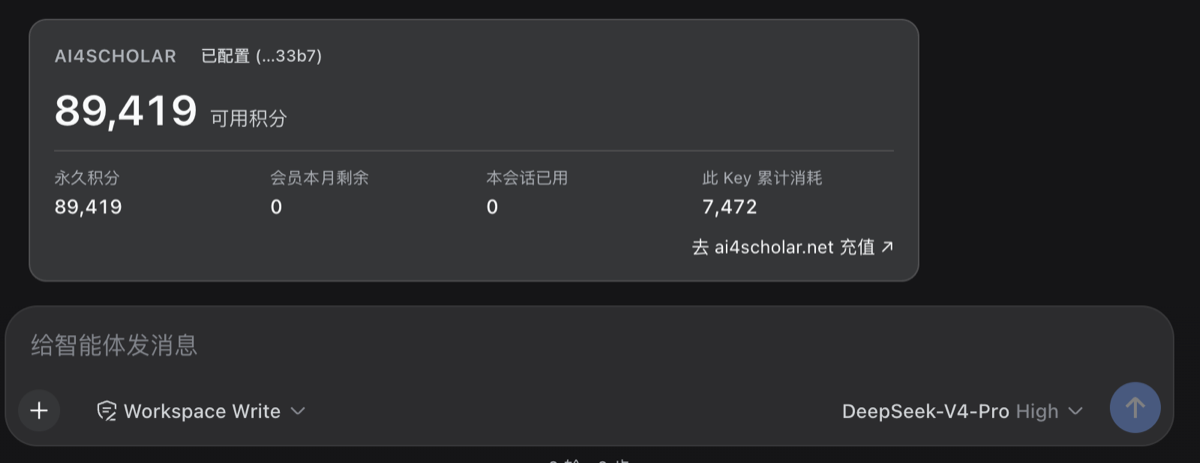
**Credits are visible.** Every billed tool card in the chat carries the charge in its title (`Semantic Scholar: protein folding · 10 credits · 4,990 left`), the model-facing result ends with `AI4Scholar credits — this call: 10 · this session: 40 · remaining: 4,960` (from the API's `X-Credits-*` headers) and the model is asked to close a billed turn with a one-line credit note; `/ai4scholar` renders a balance card (available credits, breakdown, membership, key status, session spend) and `get_ai4scholar_credits` gives the model the same numbers. Free platforms (arXiv, bioRxiv/medRxiv, DOI) carry no credit line.
## Screenshots
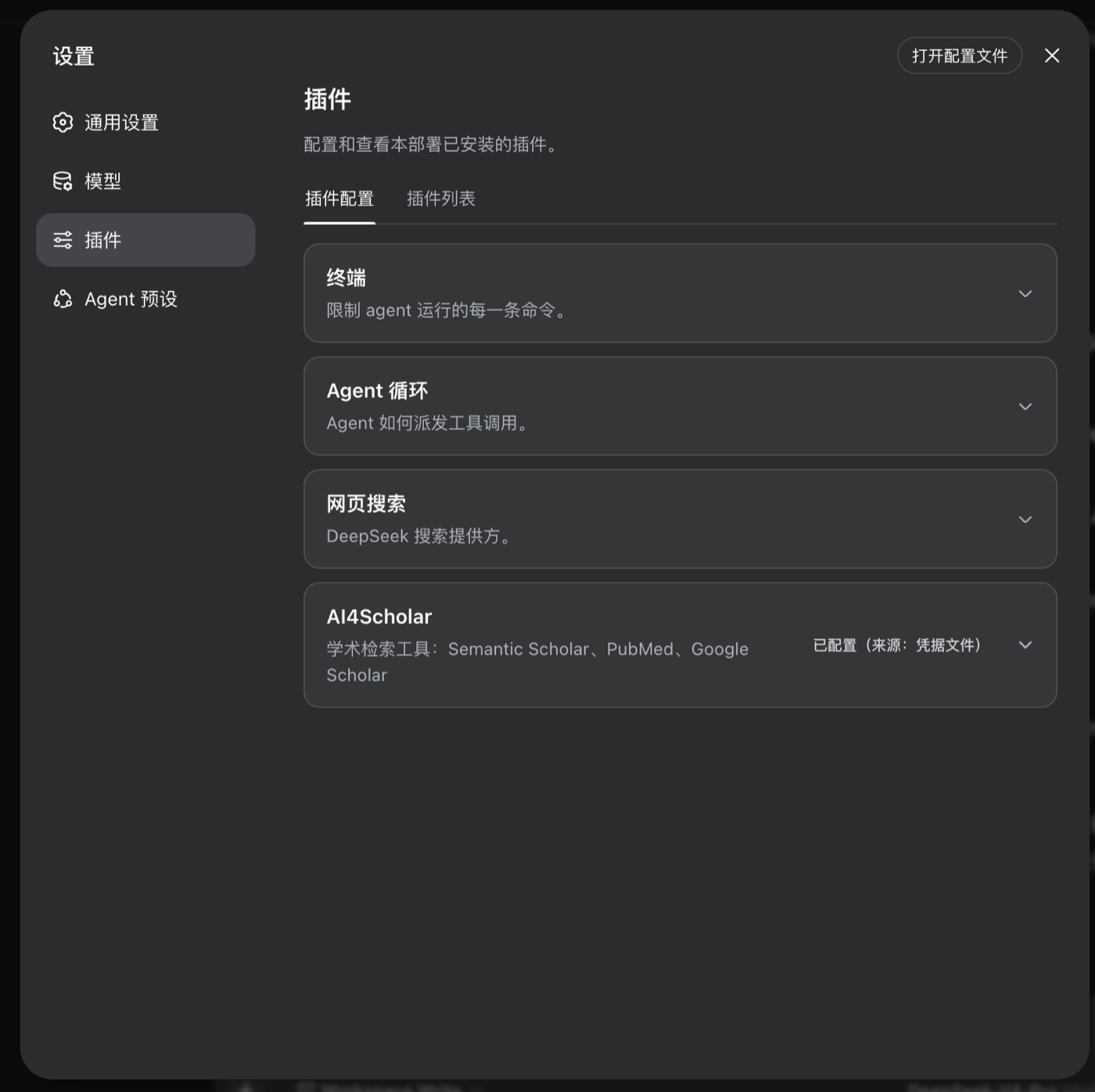
| Settings → Plugins card | `/ai4scholar` balance card |
|---|---|
|  |  |
## Install
**Quick start** (macOS / Linux; Windows PowerShell is the same):
```sh
# 0. Prerequisites: Node.js ≥ 22.19 (or ≥ 24) and pnpm (dsh manages plugins with pnpm)
node -v
npm i -g pnpm # skip if you already have it
# 1. DeepSeek Harness
npm i -g @deepseek-ai/dsh
dsh --version
# 2. This plugin (into the web profile; use --profile headless for the CLI runner)
dsh plugin --profile web add dsh-ai4scholar
# 3. Start
dsh web # prints http://127.0.0.1:3080
```
Then, once, in the browser:
1. **Settings → Models** — paste your DeepSeek API key ([platform.deepseek.com](https://platform.deepseek.com)).
2. **Settings → Plugins → AI4Scholar** — paste your AI4Scholar API key ([ai4scholar.net](https://ai4scholar.net?src=dsh)) and press **Save**. The card stores it in the dsh credentials store (`$DSH_HOME/.credentials.yaml`, mode 0600, the same place the Models page keeps provider keys), tests it at once (`✓ Key works · 89,419 credits available`), and it takes effect on the next tool call — no restart. A **Refresh** link re-checks any time; the browser never sees the key (the check goes through the plugin's host route `GET /ai4scholar/balance`).
Pick a workspace folder and ask away. Upgrades: `dsh plugin --profile web add dsh-ai4scholar@latest`, then restart `dsh web`.
Prefer files or CI? The plugin resolves the credential reference `AI4SCHOLAR_API_KEY`, so any of these also work (highest precedence first): `export AI4SCHOLAR_API_KEY=…` in the shell that launches dsh · a line in `$DSH_HOME/.credentials.yaml` · a line in the project or `$DSH_HOME/.env`. The card reports which layer is supplying the key and goes read-only when the environment does. Headless has no settings page, so use one of these there.
Releases are pushed to npmmirror right after publishing, so the default registry in China serves new versions within a minute as well.
Verify the layer without booting: `dsh --profile web --dump-config` prints a `# == dsh-ai4scholar` section.
Then just ask:
> Find recent papers on CRISPR base editing for sickle cell disease and compare their delivery methods.
> Search PubMed for GLP-1 receptor agonists and cardiovascular outcomes since 2022, sorted by date.
> Which paper is "Attention Is All You Need"? Give me its DOI and citation count.
## Configuration
The bundle mounts one row (`id: ai4scholar`) with these defaults. Override from your profile's `cordis.patch.yml` (a patch replaces the whole `config`, so restate every key you keep):
```yaml
- id: ai4scholar
config:
apiKeyEnv: AI4SCHOLAR_API_KEY # credential reference; the key itself never lives in config
baseUrl: https://ai4scholar.net
# tool families
semanticScholar: true
pubmed: true
googleScholar: true
arxiv: true
biorxiv: true # bioRxiv + medRxiv
doi: true
fullText: true # the read_* tools (PDF download + text extraction)
autoCite: true
sciDraw: true
creditsTool: true # get_ai4scholar_credits
command: true # the /ai4scholar slash command
balanceRoute: true # GET /ai4scholar/balance for the settings card's key test
showCredits: true # credit line on billed results
promptGuidance: true # short system-prompt section describing the tools
promptOrder: 150
# sizes
defaultMaxResults: 10 # when the model omits max_results
maxResultsCap: 50 # hard upper bound per call
abstractMaxChars: 600 # abstract characters shown per paper; 0 hides abstracts
readMaxChars: 60000 # characters per full-text slice
# timeouts / retry
requestTimeoutMs: 30000 # per HTTP attempt
pdfTimeoutMs: 120000 # per PDF download
generationTimeoutMs: 300000 # auto_cite / sci_draw
maxRetries: 3 # attempts on 429 / network errors
retryBackoffMs: 2000 # doubles per attempt
toolTimeoutMs: 180000 # cooperative per-call budget enforced by dsh
```
The API key is resolved **per call** through `ctx.credentials`, so storing or rotating it takes effect on the next tool call without a restart. When the credentials service is absent (a custom composition), the plugin falls back to `process.env[apiKeyEnv]`.
The settings card always edits `AI4SCHOLAR_API_KEY` (the browser half does not receive the row config); a deployment that overrides `apiKeyEnv` manages that reference through the environment or the credentials file instead. The session credit tally is process-local (it restarts with dsh); the balance itself always comes from the API.
## How it fits dsh
- Two halves in one package: the Node half registers the tools; the browser half (`exports["./client"]`, declared by `dsh.client`) contributes the settings card through the `settings.plugin.item` slot and talks to the Host only through the credentials wire API — the key literal never rides a response, and it never reaches the model.
- Tools are registered on `ctx.tools` with `defineTool`: typed, schema-validated arguments; a canonical JSON value per call (`{ source, query, total, papers[], truncated, nextOffset? }`); a Markdown rendering for the model; and a `web` result card (structured sources) for the Web UI.
- A single `tool:ai4scholar` system-prompt section tells the model when to use which platform and to cite by DOI/link.
- Everything is an effect: unloading the plugin (or editing its config, which triggers HMR) withdraws every tool and the prompt section.
- No model-visible input is added outside the tool results, so sessions stay fully replayable from the log.
## Development
```sh
pnpm install
pnpm test # builds lib/ (Node half via tsc, browser bundle via tsdown), then runs:
# unit tests, a smoke test against the real ToolRuntime, and a jsdom test that
# loads the built client bundle under the dsh module-host contract and drives the card
pnpm typecheck
# try it in a dsh profile without publishing:
dsh plugin --profile web add /absolute/path/to/dsh-ai4scholar
```
`dsh plugin add github:<you>/dsh-ai4scholar` also works: the `prepare` script builds `lib/` from source, and pnpm asks you to allow it once via `allowBuilds` in the profile's `pnpm-workspace.yaml`.
## Notes
- `download_by_doi` / `read_by_doi` resolve through doi.org and known publisher PDF patterns (Elsevier, Springer/Nature, Wiley, T&F, MDPI, IEEE, ACM, ACS, RSC, PLOS, Frontiers, bioRxiv/medRxiv, arXiv). Paywalled articles only download when dsh runs on a network with institutional access; a refusal names the landing page so the user can fetch it by hand.
- Full-text extraction uses `pdf-parse` (pdf.js) in-process; scanned/image-only PDFs yield an explicit error rather than empty text.
- The same tool set ships for [OpenClaw](https://github.com/literaf/ai4scholar-plugin-openclaw), [Codex](https://github.com/literaf/ai4scholar-plugin-codex) and [Hermes](https://github.com/literaf/ai4scholar-plugin-hermes).
## License
MIT
Install
dsh plugin --profile web add dsh-ai4scholar@0.3.6
Profile: web
With the hub plugin installed, ask your agent to install it by name — it resolves the same plan shown here.
dsh plugin --profile web add github:stvlynn/dsh.fish#path:packages/dsh-plugin-hub
install dsh-ai4scholar from the hub